2024 Arctic Report Card reveals a concerning trend in Arctic nations
The Arctic saw the second warmest year on record since 1900
ANCHORAGE, Alaska (KTUU) - The Arctic is rapidly changing, and an annual report released Tuesday on the northernmost environment points to some notable findings in this year’s research.
According to the National Oceanic and Atmospheric Association (NOAA), environmental changes included record warmth, caribou herd declines and increased wildfire seasons.
The report, which NOAA published on its website on Tuesday, details key findings of changes happening in the ocean, on land and in the air across all Arctic nations over the past year.
“This year’s report demonstrates the urgent need for adaptation as climate conditions quickly change,” said Twila Moon, lead editor of the Arctic Report Card and deputy lead scientists at the National Snow and Data Center, in a press release.
The 114-page report opened with several dozen key findings — dubbed headlines. Read on for a snapshot of those key findings and the report seen from the perspective of an Alaska climate specialist.
Key Findings On Land
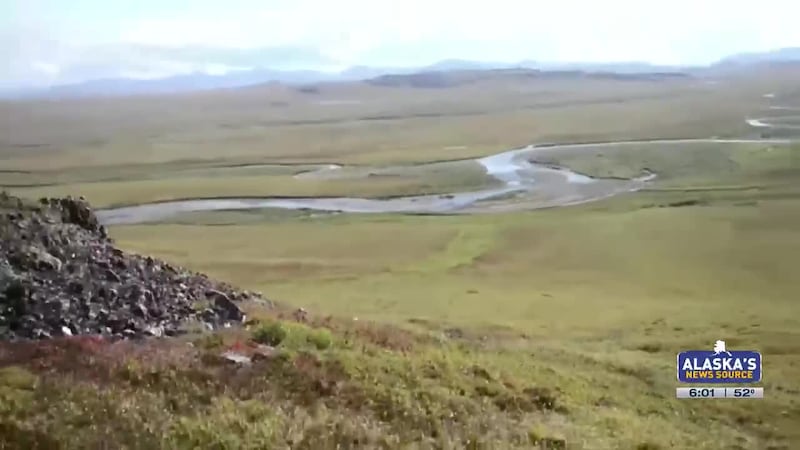
- The Arctic tundra region has shifted from storing carbon in the soil to becoming a carbon dioxide source (ARC, page 3)
- Alaskan permafrost temperatures were the second warmest on record (ARC, page 3)
- Arctic migratory tundra caribou populations have declined by 65% over the last two to three decades (ARC, page 3)
- Tundra shrub cover ranked second highest in the 25-year satellite record (ARC, page 3)
Rick Thoman, an Alaska climate specialist who works at the University of Alaska Fairbanks, told Alaska’s News Source one of the most concerning new findings this year is how carbon is cycling around the Arctic.
According to Thoman, areas with permafrost have historically been where carbon accumulates as carbon tends to store more readily in cold soil which slows down the decomposition process.
Thoman says thawing permafrost is releasing huge amounts of carbon back into an atmosphere already full of record levels of heat-trapping pollution.
“Between the warming environment and the big increase in wildfire activity in permafrost areas all around the Arctic, the Arctic is now tipping from an area where carbon accumulates to becoming a carbon source,” Thoman said.
This means that both carbon dioxide and methane are released into our atmosphere, both heat-trapping gasses. Thoman said there are still areas of carbon sinks, where more carbon is being stored than released into the atmosphere, but the overall picture is that many of the permafrost areas have now tipped into being small carbon sources.
“This is yet one more sign, predicted by scientists, of the consequences of inadequately reducing fossil fuel pollution,” NOAA Administrator Rick Spinrad said in a statement.
Carbon is also released into the atmosphere during wildfires, which have increased in both Eurasia and North America over the last 50 to 70 years.
“We’ve got a lot of fuels available,” Thoman said. “One of the unique things about boreal and Arctic wildfire is not only do we have plant material on the ground that can burn, but in that duff layer in the boreal forest, you’ve got all this undecayed organic matter that can burn in a fire as well.”
According to Thoman, big wildfire seasons like 2019 and 2022 are episodic. While Alaska’s wildfire seasons as a whole are not particularly big, they are steadily getting longer, similar to what’s happening over the long term in Eurasia, Siberia and Boreal Canada.
Environmental changes are also affecting animal migrations in Alaska, mainly the caribou population. The report details that while small, primarily coastal Caribou herds are remaining steady or increasing slightly, big migratory herds all around the Arctic are decreasing in numbers. Thoman says that while caribou populations have historically varied, this isn’t the only change in animal behavior.
“Moose are expanding onto the North Slope,” Thoman said. “Beavers are expanding into northwest Alaska.”
Changes in sea life are also occurring as oceans warm.
Key Findings In The Ocean
- In September 2024, the extent of Arctic sea ice was the sixth lowest in the 45-year satellite record. (ARC, page 2)
- All 18 of the lowest September minimum ice extents have occurred in the last 18 years (ARC, page 2)
- Ice-free regions of the Arctic Ocean have been warming at a rate of 0.5 degrees F per decade, since 1982. (ARC, page 2)
- Ice seal populations remain healthy in the Pacific Arctic, though their diets are shifting. (ARC, page 2)
While key findings in this year’s report show that ice seal populations are remaining healthy, they are seeing a change in the length of time sea ice is available for resting, pupping, pup rearing and molting. As the oceans continue to warm, the research has shown that ice seals are shifting their diet from Arctic cod to Saffron cod.
Plankton blooms are also increasing across the Arctic regions, except for the Pacific Arctic. These blooms are the base of the marine food chain, which can lead to increased biotic activity in the Arctic Ocean. However, that isn’t the case for all plankton blooms.
“The downside of that is a small fraction of algae blooms turn out to be harmful,” Thoman said. ”And that’s been an issue, say, in the Gulf of Alaska, for shellfish harvesting for a very long time.
Thoman said that while plankton blooms in the Gulf of Alaska are nothing new, the blooms are expanding into areas where historically it had been too cold.
He said that algae has the potential to impact the food webs in the ocean and because the algae going with the current could very quickly impact the food web much farther north into the North Slope coast.
Key Findings In The Air
- Arctic annual surface air temperatures ranked second warmest since 1900 (ARC, page 2)
- The last nine years are the nine warmest on record in the Arctic
- Summer 2024 was the wettest on record (ARC, page 2)
- An early August 2024 heatwave set all-time record daily temperatures in several northern Alaska and Canada communities. (ARC, page 2)
While the Arctic overall saw the second warmest air temperatures since 1900, Thoman said Alaska wasn’t on the same level of heat as the rest of the Arctic. However, parts of the Slope did see record-breaking highs last summer.
“Because we are so sensitive here in the Arctic to changes in sea ice, changes in snow cover, changes in the frozen part of our environment, including permafrost, we are going to continue to have big impacts from our changing environment,” Thoman said.
He said it’s important to slow the warming and adapt to the changes.
“I think one of the values of the Arctic Report Card is that if any evidence is needed that these changes are ongoing,” Thoman said. “We’re not in a new normal; we’re in the middle of some point along a change and that’s going to keep happening.”
Thoman says the most obvious way people notice is through extreme events that impact Alaska.
“We’ve had so many of it in Alaska, whether it’s big snow, torrential rains, landslides, river erosion and storms like Merbok forming in places they didn’t used to,” said Thoman.
In a statement, Gerald Frost, a senior scientist with Alaska Biological Research said trend of record or near-record environmental data indicates that “recent extreme years are the result of long-term, persistent changes, and not the result of variability in the climate system.”
The report concludes with the importance of understanding Indigenous knowledge and community-led research programs that can inform successful responses to rapid Arctic changes.
Past coverage
See a spelling or grammar error? Report it to web@ktuu.com
Copyright 2024 KTUU. All rights reserved.