Report: 2024 Salmon population numbers show sharp decline
ANCHORAGE, Alaska (KTUU) - A new Alaska Dept. of Fish & Game report shows that despite efforts from the state’s salmon hatcheries program — subsistence, commercial, and sport population numbers — as well as the price of salmon continue sharp decline from 2023 to 2024.
In total, the report concludes that fishermen recovered 40% fewer fish in 2024 compared to the 10-year average.
”Statewide, 34.2 million adult hatchery salmon returned to Alaska in 2024, which is 60% of the previous 10 years’ average,” the 2024 report states.
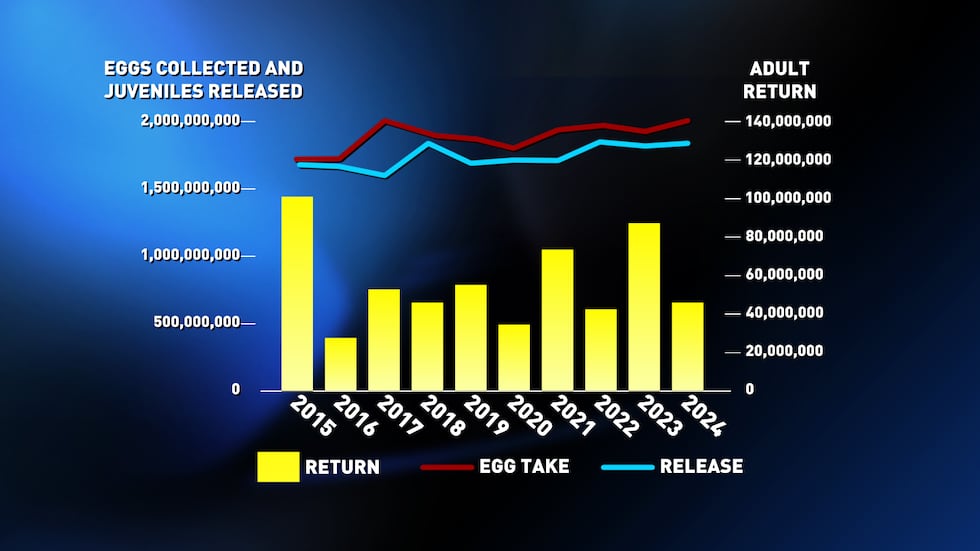
“In 2024, Alaska hatcheries released 1.9 billion juvenile salmon. A fraction of the released fish will return, contributing to Alaska’s fisheries. Hatchery releases and fishery contributions are sustainable and steady, with hatcheries contributing an average of 28% of the commercially harvest salmon in Alaska for the last decade,” ADFG Spokesperson Shannon Mason added in a statement.
In raw numbers, the report says that meant 28,000 less fish for sport, personal use, and subsistence fisheries.
The Alaska Salmon Hatcheries program — which started in the 1970s to respond to historically low salmon numbers — only raises fish and releases them into the water. Once they return to the ocean, it is up to Mother Nature.
The report also shows that despite several emergency orders closing King Salmon sport fishing, the steady, decade-long hatchery-reared salmon decline has continued.
However, the report also concludes that salmon numbers are expected to recover somewhat this year.
“Hatchery operators forecast 82.7 million salmon will return in 2025,” the report states.
This assessment is tenatively shared by Matanuska Valley Fish and Game Advisory Committee Member Andy Couch.
“The return is normally strongest in the Susitna Valley on even numbered years and weakest on the odd numbered years, and most the hatchery fish and particularly the Prince William Sound Hatchery fish it’s the opposite. They return strong on the odd number years. Same goes for the Kenai River,” Couch explained.
See a spelling or grammar error? Report it to web@ktuu.com
Copyright 2025 KTUU. All rights reserved.