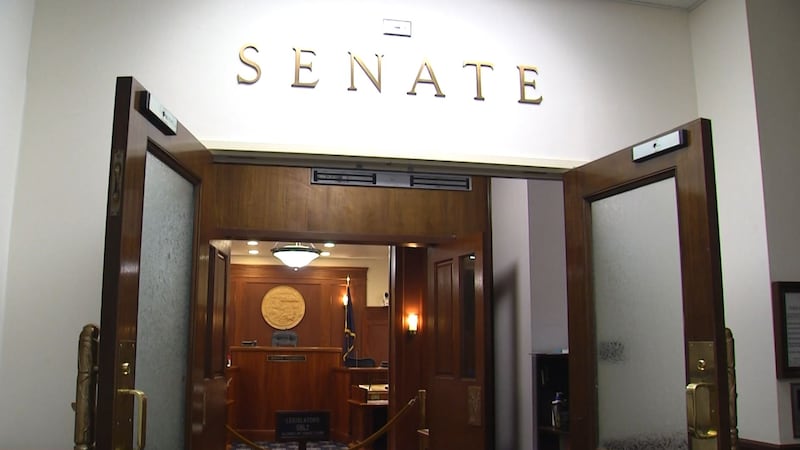
With election security taking center stage, session goes past midnight deadline with objections to legalities
JUNEAU, Alaska (KTUU) - Multipart elections bill HB 129, which combines a proposal to clean up the state’s voter rolls with election provisions, was largely responsible for causing the House to carry on well past its’ legally bound midnight deadline.
Wednesday marked the final day of the regular session, but the final call to adjourn the floor session didn’t come until 1:23 a.m. Thursday, ruffling the feathers of some lawmakers.
“The plain reading of the constitution says we’re done, our legal advice says we’re done,” Rep. Ben Carpenter, R-Nikiski, said.
Rep. Sarah Vance said because the Senate hijacked her voter registration bill she could no longer support it. House supporters who helped pass the bill in February said it dealt with over-inflated voter rolls.
“They simply added too many things that I could not agree to and get concurrence on,” Vance said. “I moved a bipartisan bill in the House, received 33 votes [in support], and unfortunately we will not be able to encourage their [the Senate’s] changes.”
The Senate version was changed to include candidate legal funds, special needs voting, absentee voting, and the use of artificial intelligence to interfere with an election.
“Just on the issue of cleaning up our ballot rolls, I know that’s a concern,” Sen. Bill Wielechowski said. “There are significant changes in this bill that will clean up our ballot rolls.”
Whereas the Senate voted 14-6 in favor of the bill’s passage, the House never got to a final vote. Over an hour after the session was legally finished, House lawmakers voted in favor of adjourning, 21-19.
“I think a lot of people wanted to see that elections bill pass, that was good policy,” House Minority Leader Rep. Calvin Schrage, I-Anchorage, said in a press scrum. “Unfortunately, I think the majority leadership didn’t want to see that move forward and that’s what we saw play out, is frankly an obstruction of the process.”
Gov. Mike Dunleavy issued a statement following the end of the session promising more work on addressing key issues.
“We are proud to have passed several bills this session that move Alaska forward,” Dunleavy said. “My administration will spend the interim preparing new initiatives for next session on public safety, education reform, expanding the agricultural sector and much more.”
Budgets & PFD
Alaska House and Senate lawmakers scrambled to pass several remaining budget bills, including some of the governor’s main priorities such as the Permanent Fund dividend, education and energy.
As part of the state’s operating and capital budgets, HB 268 goes to the governor with a $1,650 combined PFD and energy relief check.
However, a comprehensive education package was not passed. The governor receives a budget with a one-time $174.7 million funding increase, which breaks down to an additoinal $680 to the state’s per student funding formula known as the base student allocation or BSA. There’s also $5.2 million for the state’s kindergarten through third grade reading program and $4 million for extended Anchorage homeless shelter funding through the summer.
There is also $75 million for infrastructure across the state, $68 million for K-12 and University of Alaska deferred maintenance, $30 million for professional housing and weatherization and $9.7 million to help secure federal grants.
Education & Homeschool Funding
In an eleventh hour move, a temporary homeschool funding fix passed the Legislature and will head to Dunleavy.
Provisions from Soldotna Republican Rep. Justin Ruffridge’s correspondence homeschool funding bill, HB 400, were added onto HB 202, which will require school districts keep at least two opioid overdose drug kits in each main school building.
The law, which would be repealed July 1, 2025, takes into account an Anchorage Superior Court judge ruling last month regarding two state statutes that violated the state constitution for using public funds for private and religious school expenses.
HB 202 will require the State Board of Education adopt homeschool funding regulations consistent with the Alaska Constitution, as well as adopt regulations establishing standards for individual learning plans.
Also, the department or district providing a correspondence study program will be required to submit an annual report to the department, including the number of students, demographic information, and track spending along with assessment and proficiency scores of the students enrolled in the program.
However, there is no specific language forbidding public funds from being used for religious or private education expenses.
As for the opioid overdose provision, HB 202 would also require the Department of Health to provide each school district with the opioid overdose drug. At least one person trained to administer the drug will have to be present during all hours when the main school building is open to students or the public, including at each school-sponsored event and weekend activities held on school grounds.
Finally, the Commissioner of Health will have to develop and provide a short video to each school district about how and when to administer the drug.
Another education bill headed to the governor is HB 230.
Sponsored by Rep. Rebecca Himschoot, I-Sitka, supporters say the bill will help bring more experienced teachers to the state by repealing the limit on the number of years out-of-state teachers can apply toward the teacher pay scale.
Himschoot said teachers are currently only allowed to count eight years of out-of-state teaching experience if they have a master’s degree, and six years of out-of-state teaching experience if they have a bachelor’s degree, to determine the correct placement on a district’s salary scale — even if they taught out of state for much longer.
The law will also allow the Department of Education to issue lifetime certificates to retiring teachers who have a valid Alaska certificate, and offers a $5,000 bonus to teachers who hold a national board certification.
Energy
After Gov. Dunleavy called energy policies a key priority, lawmakers are sending him HB 50 to sign, which includes several provisions to address Cook Inlet’s pending natural gas supply shortage.
The bill includes creating a new loan program, which supporters hope encourages producers to have more funding to develop natural gas reserves. It also allows state to start charging companies for storing carbon dioxide gas emissions on newly created storage facilities on state land, rather than releasing the carbon back into the environment.
Supporters of another bill headed to the governor, HB 307, known as the integrated transmission systems bill, say it will modernize the railbelt electric grid, which they argue will eventually lower costs for customers.
Rep. Zack Fields, D-Anchorage, voted in favor of the bill Tuesday.
“We need to modernize our transmission system and eliminate the pancake tariffs that add costs to the cost of electricity,” Fields said, “and that allows us to deploy cheaper, clean energy sources up and down the railbelt to keep prices as low as possible for consumers.”
However, HB 223, which supporters had argued would lead to more Cook Inlet production by reducing royalty rates, failed to pass the Legislature.
Alcohol Sales
HB189 supporters were successful in pushing through a potential law change that will allow 18-20-year-olds to serve alcohol under what they called “appropriate supervision.” Supporters say this will help with Alaska’s restaurant labor shortage.
Tobacco/Marijuana
Supporters who argued SB 89 would curb youth smoking lost their battle when the legislation proposing to raise the minimum age from 19 to 21 to buy, sell, or possess tobacco products and electronic smoking products did not make it past the Senate with the end of session.
The bill faced major changes in the House, including removing a 25% sales tax on e-cigarette products.
Another major hurdle as the bill headed back to the Senate, included Wasilla Republican Rep. Jesse Sumner’s marijuana tax bill, HB 119, is attached to SB 89. The measure would have taken the current $50 per ounce tax imposed on cultivators who sell their marijuana to a retail marijuana store and reduce it to $12.50 per ounce.
That tax would have ended on Jan. 1, 2025, at which time a 7% sales tax will be imposed on anyone buying products from marijuana stores.
Crime
HB 66, which supporters including the governor who introduced the bill, argue will combat Alaska’s rising fentanyl crisis, will head to Dunleavy for his signature.
The law would add longer sentences for drug dealers and manufacturers in Alaska, specifically pertaining to overdose-related deaths.
Those in favor have championed the bill as a potential answer to stopping the flow of fentanyl into the state, while opponents have argued that longer sentences will create longer incarceration time for drug users.
HB 183, which focuses on the participation of transgender youth in sports, passed the House over the weekend after hours of debate, only to later die on the Senate floor.
This story has been updated with additional information.
Copyright 2024 KTUU. All rights reserved.